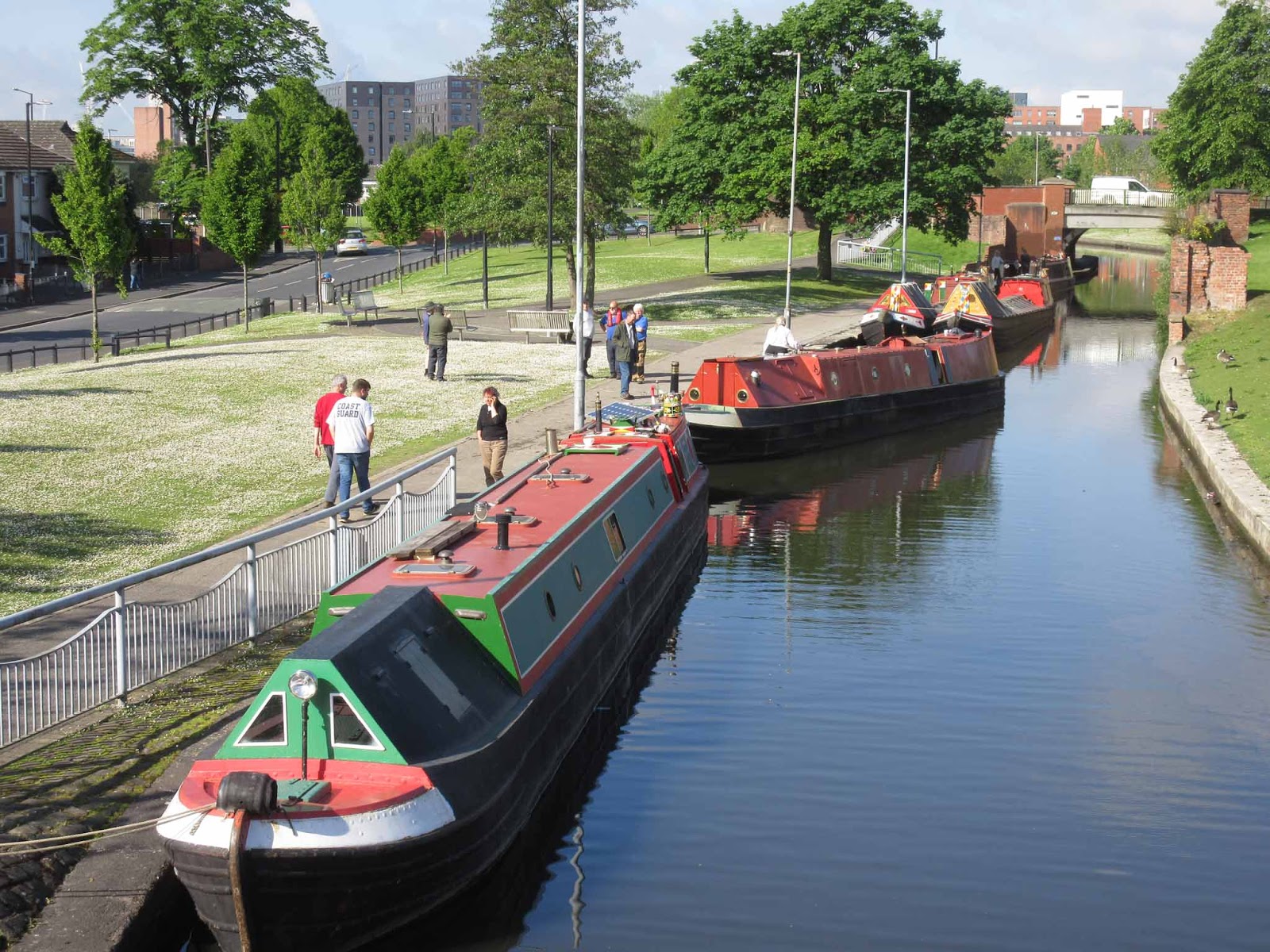
Tuesday, 21 May 2019

A somewhat better day, but still plenty of things to hold us up.

(Boat Flamingo - posted by Cath)

(Retrospective post for Tuesday 21st May)

A new travelling partner - Tasmania
Up at 6 am. I'd just got the kettle on, and was taking the dogs out of the boat when I saw Chris from the boat Tasmania. He and his crew had worked up the canal on their own the previous day, as the boat that they had been paired with was the boat that had dropped out. He said that he was leaving early, because he didn't want to be behind the convoy as he had been the previous day. I asked if he wanted us to work with him, and he agreed, but only if we could be ready by 6:30. We were, just.

Steady progress at first.
We set off up the flight, and at first, things seemed easier than the previous day with more water available. Then we got to Scowcroft Lock No 61. One of the gates wouldn't open. I was completely puzzled, it didn't seem to be jammed in any way, there was nothing on the bottom of the lock, along the cill, which might have stopped the gate moving. I have never seen a lock gate so firmly fixed before.


Until Lock 61 decided to completely halt our progress.
Only having one gate isn't a problem. One boat goes in, then pushes over to the other side, then the second boat goes in. However, once Tasmania was in the lock, and Flamingo tried to enter the lock she wedged firmly in the gates, just behind her bow. She was completely stuck.


This exerts huge forces, but still the gate didn't move at all.
We couldn't go in, and we tried reversing out, but couldn't move. We got everyone tugging on the fixed gate - it wouldn't move. We tried 'bouncing' the other gate - pushing rhythmically on the balance beam so that the gate bounces. Sometimes it's possible to dislodge a bit of rubbish that is caught behind the gate and get another centimetre or so of width.


Then we tried a 'Spanish windlass' to open the fixed gate a bit. Then on the open gate. Nothing we did made the gates move at all and nothing gave us any more width. 


Moving again.
I went back to the lock behind us, where Daphne and Swan were coming up, and explained the situation. "Oh, that lock's been broken for ages," they said, "it's supposed to be being fixed sometime."

Back at Scowcroft Lock, some of the crew from Daphne came up to give us a hand. "Put some washing up liquid along the bow where it's stuck," I was told. I did this, with little belief that it would help. David at this point was busy setting up a Spanish windlass from the bow of the boat to the bollard at the end of the lock. Once we'd got this done we tried one final attempt before calling out CRT.


Flamingo passed, errm, a flamingo.
With the boat in full forward gear, David winding the ropes to tighten the 'windlass', some people 'bouncing' the gate and a team of blokes at the back of Flamingo with a rope off the boat and a boat shaft. The pulled the back of Flamingo towards them, then pushed it out again with the shaft, wiggling the bows. Then slowly we started to see movement. Flamingo was creeping bit by bit into the lock. Suddenly she was free. We now know for definite where the widest part of Flamingo is.

We carried on, it was hard work all the way, but nothing as bad as we'd already met up with.


The ever helpful Ian Mac - 
volunteer who went far beyond the normal call of duty.
The original plan had been to stop in Littleborough, but in the pub the previous night the experienced boaters had been talking about pushing on to Summit - which, not surprisingly, is the summit of the canal. Because we wanted to keep ahead of the other boats we thought we needed to make it to the summit too. We refilled with water and emptied the toilet cassettes at Littleborough, then carried on up the locks.


Stunning scenery has replaced the dreariness of the Manchester suburbs.

Some way up the flight Ian Mac, the CRT volunteer lock-keeper, appeared. He was going to help us up to the top, because he had ways of making water available that we didn't have. He also told us that the other boats had decided to stop in Littleborough, and that Saltaire was still behind us, carrying on to Hebden Bridge, but by now we were too far up the water-scarce flight to stop. The crew on Tasmania were particularly keen to get to the summit before 8:00 pm as that was when the pub stopped serving food, so we were worried every time that Flamingo got stuck again, feeling the time ticking away.

It would not pay to ignore any of these - 
we jammed in locks which didn't have them.
We singled out for the two narrow locks three and four down from the summit, as these were narrow because of subsidence, then Ian Mac said that he wanted Tasmania to tow Flamingo through the next pound and disappeared to find some more water. It didn't work well. Tasmania grounded, Flamingo needed to be reversed to stop it hitting the back of Tasmania - which got Flamingo 'stemmed up', grounded and skewed across the canal. I went up at the next lock where I met Ian coming back down the flight on his bicycle. He said that water was on its way, and I could see a bit drizzling over the top gates. 

Much of the time Flamingo managed to match Tasmania's speed...
Tasmania, being shallower draughted than Flamingo, got off the mud, and made it to the lock. Flamingo took a lot more to move, but finally made it to the lock as the water in the pound was rising. By this point the water drizzling over the gates had turned into a cataract waterfall, and the noise was deafening. Ian had told Alan that he needed to rush into the lock to make sure that he got in against the flow of water. Unfortunately Tasmania had floated back in the current, and as Flamingo got to the lock the two boats jammed firmly in the gates again. Nobody was very happy, but with Ian's calm advice we set up another Spanish windlass to the narrow bridge at the foot of the lock and started bouncing the lock gates again. 


...however, sometimes it didn't!
We got to Summit at 7:30, a 13-hour day. Not quite as exhausting as the previous day, but longer. We all went to the pub with Ian and shared a meal together. By mutual agreement it was decided that as all the other boats were well behind us, and because of the narrowness of the locks, we might actually get on slightly better travelling separately the following day, now that the worst of the trip was supposedly over.


Rose of Lancaster Pub to West Summit Rochdale Canal
Miles 10.8, Locks: 27
Total Miles 175.9, Total Locks: 145

Monday, 20 May 2019

Undoubtedly the very hardest day's boating we have ever done

(Boat Flamingo - posted by Cath)

(Late post for Monday 20th May)


Note: We have become aware that quite a few non-boater friends are reading this blog, and we are often using boater terms that may not always be obvious. For this post I have added some annotation for some of the terms used.

Let battle commence
The seven boats that were heading up the Rochdale canal were gathered in the basin. Flamingo and Saltaire were scheduled as the first two boats to set off at 7:30. We would be met by CRT volunteers a couple of locks up.


Struggling out of channel past "the shed"
Because the Rochdale canal is prone to vandalism, especially in the Manchester area, we were equipped with CRT ‘anti-vandal handcuff keys’. Most locks would need to be unlocked, but as we had several boats close behind us we wouldn’t need to re-lock them.


All boats held shortly after the start for lack of water
No problems at the first couple of locks, then Saltaire got stuck passing a moored "floating shed" - a somewhat infamous "vessel" that has challenged the question "does this actually count as a boat?". The "shed" was sufficiently wide that the boats had to go ‘out of channel’ to pass it. The very deep draughted historic boats can ground in the shallower water and get stuck. Although I was on the tow-path with the dogs, I couldn’t see Lynette on Saltaire as she was on the other side of the "shed". I was aware that she was trying all the usual tricks to free the boat, but nothing seemed to be happening. Eventually, the boat began to move, but it would set the scene for the day.

Moving again, at last.
At the third lock we were met by the CRT volunteer lock-keepers, who told us to moor up, there was no water in the pounds (#1) ‘for miles’. We sat down for a long wait.
In the end we were free too go in about an hour and a half, but all the pounds were low and the boats scrapped the bottom. They also stuck going into the locks, as they grounded on the cills (#2). At every lock after the first few we needed to have teams of boaters hauling on ropes to get both boats into the lock. These strapping men were from the other boats in the convoy. Fortunately they were far more experienced at boating in these challenging situations than we are, and were kind enough to provide much-needed muscle. 


There are some seriously deep locks
Saltaire seemed to get stuck even more than Flamingo, which puzzled us, as Saltaire is, like Flamingo, a ‘Large Northwich’ ‘Town Class’ (#3) – and so will have the same underwater profile at the back end, and, if similarly ballasted down, the same draught. Saltaire seemed to be ballasted to be no more than an inch deeper in the water at the back end than Flamingo, but got stuck far more easily. We were surprised to find that sometimes standing a couple of people on the front was enough to change it from impossible to move, to moving easily into the lock.

SERIOUSLY deep
Saltaire also seemed to pick up quite a few 'blade-fulls' (#4), stopping the engine dead - obviously losing all power and steering at the same time.


A recurring theme


Our saviour Ian Mac, and the offending object from the lock cill
At one lock it proved impossible to shut the bottom gates. Although we had several burly blokes trying to shut the gate there seemed to be something squashy stopping the gate shutting. We waited while someone walked up from one of the following boats with a keb (#5). Ian Mac, the CRT Volunteer, fished around on the cill with the keb from the back of one of the boats and managed to remove something that looked like a distorted carrier from the back of a motorbike.
 
The business end of a keb - a very useful tool on a canal as bad as this one.

Flamingo has Saltaire in tow
At about three miles out of Manchester, with some 15 locks done, we came up through a lock at the time when kids were going home from school. Some of them watched over the bridge below the lock, discussing what was going on. Ellie, perhaps 11 or 12 years old, was particularly fascinated. She wanted to know about how the lock worked, why we were in the boats, and she asked many questions about the history of the boats. She got a phone call from home asking where she was. "It's alright, I'm watching the boats in the lock." As we left the lock she began to walk up the towpath with me, telling me that she lived in that area. "Do you like living here?" I asked. "S'oright, I s'pose, but things have been getting really bad recently, you know, murders and gunshots." I wasn't surprised about the phone call checking why she wasn't home yet.

Alan can still raise a smile at this stage.
The next three locks are narrow (Tannersfield locks), not because they were designed as narrow locks, but because of subsidence. We had to separate from Saltaire, and go on alone for a while. Meanwhile Saltaire had picked up another 'blade-full', and Lynette needed to go down the 'weed hatch' (#6) to clear the prop.


One technique for getting a boat into a lock.


Alan re-enacts a scene from Star Wars


Towing again

 
View back to Saltaire


David performs his civic duty, removing shopping trolleys from the cut...
At the second lock up, there were 3 shopping trolleys in the 'apron' of the lock. David got the 'short shaft' (#7), and fished them out of the cut, dripping weed. He then took them back to Morrisons.


... and returning them to Morrisons!
There is a fairly long pound after Tannersfield, so I got back onto the boat, having walked the dogs up until that point. We set off for the next lock, expecting to see Saltaire arrive behind us. However, the next boat we saw was Daphne. Bob, one of the owners, told us that Saltaire was still trying to clear the prop, and we should go on alone, as he was travelling with Swan.

After Failsworth, (where we got stuck on a mud 'scour' again, and were rescued by the experience, knowledge and muscle of Bob, from Daphne).  We were told by Ian Mac the CRT Volunteer Lock-keeper to either stop in half an hour at the Boat and Horses - where it was difficult to get to the side, or keep going for an hour and a quarter and stop at the Rose of Lancaster, where moorings were good. 

Still going, but by now travelling alone
We saw the moorings at the Boat and Horses, we couldn't have got within five or six feet of the bank - and there would have been no way to get the dogs on or off, so we carried on to the Rose of Lancaster, arriving at about 8 pm. No problem, the website said that they served food until 9 pm, but with a quick phone call to check it turned out that they stopped serving food at 8 pm. So, I cooked something simple, and we went to the pub with the other boaters who had turned up by then - all except Lynette and Sue on Saltaire. The story in the pub was that they were turning back, so we knew that we wouldn't be working with them on the next day.

Something a bit different - a vertical lift bridge.
The day was something over 12 hours, almost all of it was fighting to get into locks, or struggling to get off mud scours, or shopping trolleys, or whatever the good people of Manchester had thrown into the canal. Everyone decided to get off early the next day, so I set the alarm for 6 am, expecting to go at about 7:30.


VOCABULARY for non-boaters:

#1 'Pound' - the length of canal between two locks, it could be a very short distance, or it could be many miles.

#2 'Cill' - the gates of the lock close against an underwater ledge, often constructed of stone, which limits their movement and forms the water seal. However, it is not unusual for rubbish to get caught against the "cill", and prevent the gates from shutting, then rendering the lock inoperable until cleared.  The issue is that it is several feet below water, and you can't actually see what the problem might be.

#3 'Town Class' - in the mid 1930s the Grand Union Canal Carrying Company commissioned a fleet of large carrying boats from Harland and Wolff at Woolwich, Yarwoods at Northwich and Walkers at Rickmansworth. The larger of these were named after towns, hence 'Town Class'. Flamingo was originally called 'Letchworth', but was renamed by Willow Wren who bought her in the early 1960s.

#4 'Blade-full' - when your prop (propeller) picks up the rubbish that has been thrown into the canal. It can be anything from plastic bags upwards. Things we have had on the 'blade' in the past include: double duvet, carpet, jogging bottoms, specialised hospital escape equipment, rope mixed up with fishing line - including fishing hooks and a motorcycle tyre. This can stop your engine dead - but not your boat, which will carry on in the same direction.

#5 'Keb' - a sort of rake on a very long shaft, and with the tines at 90 degrees to the shaft used for getting rubbish out of the canal. An invaluable item, but seldom carried on a boat because they are large and unwieldy.  Fortunately some boats attempting this trip had one, as we did not.

#6 'Weed hatch' - modern boats have a hatch in the bottom of the boat (above the water level, and with a removable lid) which allows access to the prop to remove rubbish. Most historic boats don't have 'weed hatches', Saltaire is unusual that it has been modified to have one.

#7 'Short shaft' - pole about 8 feet long, with a robust steel hook hook on the end - the modern day equivalent is often called a "boat hook".  On the other hand a 'Long shaft' is the long pole, (maybe 15 or 16 feet)  used to help get the boat off a mud scour when it has grounded, or to push a boat away from a bank - what most people would call a 'barge pole'.
 
Manchester to Rose of Lancaster Pub
Miles 7.2, Locks: 20
Total Miles 165.1, Total Locks: 118

Sunday, 19 May 2019

Sunday 19th May - Day in Manchester

(Boat Flamingo - posted by Cath)

The first  pound we will need to go through tomorrow
Woke up fairly early, and decided that we would try to stock up on a few useful things for tackling the Rochdale Canal - like bolt croppers.

So after breakfast Alan and I headed a short way up the canal to Urban Exchange - which seems to be a fancy name for a car park with an Aldi, a gym, a Go Outdoors and a M & S Outlet store. 


More water will definitely be needed!
When I'm boating I need quite a few sets of clothes that can get mucky, so I was looking for some cheap jeans and a cheap easy-care jumper. In my attempts to not pack as much as usual (which then doesn't get worn) I failed to bring enough 'mucky clothing'. I didn't find anything suitable , but I bought some nice running stuff in Go Outdoors and another jumper in M & S. 


Samuel Barlows "Daphne" - a wonderful wood built boat
Then off to Tool Station for the bolt croppers. 

Back at the boat we ate a very hasty lunch and headed off to Arndale Manchester. Alan had been hoping to head for an interesting shopping area, and he complained that he could be going to the Arndale in Luton. Despite this, the old buildings in Dale Street were interesting, and we did find an M & S for jeans. 


Swan arrives up the Rochdale 9, its single cylinder Gardner barking away
I think I have probably lost a couple of pounds on this journey, since I haven't been hitting the pub dinners and alcohol too much, and I have been working hard. I wasn't expecting to find myself fitting into size 10 jeans - the first pair I believe that I have ever owned. This says very little about any weight loss and a great deal more about 'vanity sizing'.


Swan with Flamingo, Daphne & Tasmania
We bought a few other things: camping chairs, a new clothes airer, then back to the boat to dog sit, and let David head off to do some things that interested him.

Then the afternoon was largely taken up with pottering about on the boat and writing up some blog posts. At one point a couple of boys smoking weed asked Alan if they could come into the boat, since they had never been on a boat. Alan declined, as it would 'wind the dogs up'. In fact, this is our home while we are away, however interesting to people on the towpath. They then asked Alan if they could stand on the boat to smoke, and he said OK. 

Joel and Maria - we are being spoilt for wooden boats.
This did wind the dogs up a bit. Max did a few 'wuffs', and they were running up and down inside the boat, so I went out to see them and explain. I chatted to them for a while, did they live locally? One lad explained that he lived in the Travelodge, waiting for housing. They didn't do much except sit by the water and smoke weed - there was nothing else to do. I didn't know what to say, it just seemed so incredibly sad. Manchester is undergoing massive regeneration. Old warehouses turned into chic apartments, posh waterside apartments everywhere - but no social housing. These boys were quiet, and resigned, what will they be like in five years time? 

Everybody that is expected to depart on Monday is now gathered.
The other boats in the convoy turned up during the afternoon.

Early to bed, but my brain just wouldn't switch off - just when I needed a good night's sleep

Saturday, 18 May 2019

Onwards into Manchester and the boater unfriendly "Rochdale 9"

(Boat Flamingo - posted by Cath)

(Retrospective post for Saturday18th May)
The really rather lovely "Stork"

The electrical charging system on Flamingo doesn't seem to be performing quite as expected, and having already discovered some slight anomalies by the use of a voltmeter at various points on the system, Alan decided a bit of further investigation needed to be carried out, if only to rule out anything obvious.


This site is being developed - we hope this survives.
Alan thought a large high quality switch in the system was possibly slightly defective, and we had already stopped at a couple of chandleries we passed to see if we could buy a spare, but none had had anything suitable. He therefore decided to remove it and take it apart to check condition.


An unwanted stone attack - fortunately no serious damage done
In the meantime I decided to go for my third run of the week. Following the NHS 'Couch to 5K' programme makes things very easy for me. I listen to the podcast on my phone, I 'run' when I'm told to, I walk when I'm told to. It is easily manageable, and I can't overdo things. Once I've done it, I don't find myself thinking 'I should run further/faster/more often/etc'. When I first took up running, some 34 years ago I spent a lot of time feeling that I ought to be doing more. This takes all that away. I do what I'm told, and I expect that at the end of the programme I'll be able to shuffle along for 30 minutes.


On the "Rochdale 9" some locks are cranked rather than pushed open.
Back at the boat they hadn't identified a problem with the switch - they had been able to get to the internals, and all seemed in good order, so we set off towards Manchester anyway.


Typical of the modern buildings as you climb the Rochdale 9
After my shower, and washing David's wet clothes from falling in the canal a couple of days ago. I did my stint on steering, but then told Alan that if he wanted any lunch he needed to take over again


Attractive rail bridge on the Rochdale 9.
I had just taken Alan's sandwich to the back of the boat, and was sitting down to eat mine when I heard a noise that disturbed me. Rushing out to the back of the boat there were three or four boys lobbing fairly large pieces of railway track ballast at the boat as it came under the bridge at the junction with the Rochdale canal. This is always a hazard in urban areas, but we haven't had it happen very often. Alan had been struck by one of the rocks, but fortunately not on his head, which would have caused quite a lot of damage. I grabbed the camera, but they rushed off and hid. This kind of thing sours the day, but there is nothing that you can do about it.

We carried on to Castlefield Basin, in the hope that we might be able to moor in Central Manchester, but there were no spaces left. There was only one thing for it, up the Rochdale Nine to the Dale Street Basin, which is where we will need to set off from early on Monday morning. 

Arrow marks where the River Tib passes under the canal (see below)
Slight problem. A very large trip boat had moored in the entrance to the bottom lock, and was boarding a very large hen party. Young women in flimsy clothing and very high heeled shoes were tripping down the cobbled path to coo at each other and kiss the air. The men with the widebeam boat were not wild about us asking them to move so that we could get up the flight.

Eventually we got into the first lock. This is not an easy flight, so we decided that Alan, who is the most experienced steerer, would stay on the boat, and David and I would work the locks. The dogs would need to get off and walk up the flight with us. I tied them up beside the lock and immediately they were surrounded by young women from the bar by the lock who wanted to pet them. This is bliss for the dogs, they can take any amount of fussing.

This building looks impressive on the street side...
The funny thing about boats, especially historic boats, is that everyone who passes will be an expert about what you need to do. It doesn't seem to occur to them that you might actually have done this before. Our standard practice is to raise the button fender at the front, then take Flamingo up to the gates, having her running in forward gear, with the bows against the gates. This is particularly important going downhill, to prevent her floating back onto the cill - which can be disastrous, and is the most common cause of boats sinking in locks. In this case we were going uphill, but it is still the same, as the boat barely fits into the lock. Alan edged Flamingo up to the upper gates and we shut the lower gates behind the boat. We were just starting to wind the paddles to let water into the lock when a man rushed over to David. "The front of the boat is getting wet, you need to move it backwards." David pointed to the back of the boat at the other end of the lock, "where would you like us to move it back to?" "But the front is getting wet!" said the man. "Yes," agreed David, "it does that."


...but nothing like as impressive at the back!
The Rochdale 9 are pigging awful. Filthy, with poorly maintained paddles and gates and low water levels. There were piles of needles in corners, and everywhere smells of piss. They really are unpleasant and hard work. To make it worse, you can't even walk between all the locks, so the dogs had to be loaded off and on before and after each lock, as they really wouldn't have enjoyed being banged about in boat in the lock as it filled.


Not many factory chimneys left here now
David was interested in looking for and finding the arrow on the coping stones in one of the pounds. This marks the trapdoor into the River Tib which is culverted under Manchester. This is one of Manchester's hidden rivers, but from Roman to Medieval times it was a boundary. There is a wooden trapdoor on the bottom of the canal which can be lifted to empty the pound into the river.


There was a brief moment's interlude. Canal Street, that you pass about half way up the flight is Manchester's 'Gay Village'. There is a fairly high wall along the side of the canal, which people passing up and down Canal Street peer over to watch the boats going past. From the canal you can't see much except the tops of people's heads. There was a fairly raucous hen party sitting outside one of the pubs, and they began screeching loudly. David and I were a little surprised, so stood on the lock gates to see if we could work out what was going on. What we could see was the tattooed torso of a male stripper performing for the hen party. "David, you're taller than me, has he got any kecks on?" I asked. "I can't see," replied David, "I suspect not, given the screaming, but I'm not sure that I want to know."


A select area we are passing through!
At the top of the locks is the basin. There were two boats there already, Tasmania, and Saltaire. We chatted to the people on board them, and discussed that it might be noisy, given that it was Saturday night.

One of the last locks is entirely underground
It was. From early evening there were boys and a few girls sitting on the benches smoking weed. A little later a noisy group of young men arrived to play loud rap music, and drink. They ignored the boats, but it was loud. Then suddenly, at about 11 they disappeared. There were small groups of men sitting around, smoking weed and talking until quite a lot later, but no more noise and we managed to sleep quite well.


Lymm to the top of the "Rochdale 9" in Manchester
Miles 14.8, Locks: 9
Total Miles 158.0, Total Locks:98

Friday, 17 May 2019

One very small lock - one rather larger tunnel

(Boat Flamingo - posted by Cath)

(Late post for Friday 17th May)


I was woken by heavy rain in the night, and it was still raining when we got up. We'd thought that it might be cloudy, but we weren't expecting heavy rain. Alan somehow got volunteered to start the steering for the day.

The curious stop lock at Dutton, just before Preston Brook Tunnel
Shortly before Preston Brook Tunnel, near Dutton, we went through the stop lock at Dutton. This is weird, as the lock is wider at one end than the other. Which must restrict the movement of some of the huge brick-like 'widebeam narrowboats' (contradiction in terms) that we have started to see again now that we are out of the narrow canals and locks of the south Midlands. Near to this is a wet dock, that used to be leased by Tim Leech, but since his untimely death a couple of years back this seems unused. It is sad to see places that were once thriving canal businesses unused.

Waiting for a timed passage at Preston Brook.
Preston Brook Tunnel is one-way at a time, so allows entry for only ten minutes every hour - on the hour to ten past going north, from half past going south. We had to tie up and wait for a while, as we had just missed our passage north.

We turned right onto the Bridgewater canal at 'waters meet' but moored at a pleasant spot very soon afterwards for lunch. After that it is lockless miles. The canal is broad, and deep, allowing even Flamingo a fairly easy passage, but there are long sections of on-line moorings, meaning regular slowing to a crawl. People tend to notice Flamingo, not just because she is noisy, so we don't risk upsetting people by thrashing past. 

The miles to Lymm went fairly quickly, with Alan and I taking turns at steering. At Lymm we found a nice mooring and I walked to the local Sainsbury's to go shopping - again. Then I cooked dinner, leaving mine to heat up later, and walked up the hill to the local leisure centre where I went swimming.

Another boat still trading on retail fuel - Liam with Bellatrix
I have a plan to go 'wild swimming' with my brother when we get to Hebden Bridge. Paul lives in Huddersfield, and regularly takes part in local triathlons, so is used to open water swimming. Odin Dogge loves swimming, so we are hoping to take him swimming near to Hebden Bridge - he doesn't yet know that people can swim too. Paul has advised me to buy a wet suit to avoid hypothermia (yes, I have a wet suit on the boat). I've bought the cheapest that I can, since I'm not sure that I will ever go 'wild swimming' again. However, it is several years since I last went swimming anywhere, so I thought that I should try to find a pool to make sure that I can still swim.

Delphinus - a "Small Northwich" like Bellatrix, but with a cabin conversion.
Note by Alan - I am very happy that Cath is now far better equipped to go in the canal than I am should we get a major fouling of the propeller on this trip, that it is not possible to clear by just being on the bank!

Back at the boat I ate my dinner and fell asleep very soon afterwards. I've walked miles today, and I really am not used to swimming.

Further note by Alan - Whilst Cath went swimming, I took both dogs for a fairly extended walk up the towpath, eventually finding some adjoining fields that allowed them to run around considerably more, and to burn off energy.


Near Saltersford Tunnel to Lymm (Bridgewater Canal)
Miles 15.3, Locks: 1
Total Miles 143.2, Total Locks:89