Saturday, 6 July 2019

Back into Manchester

(Boat Flamingo - posted by Cath)
Saltaire and Flamingo about to break out after a hold-up of four weeks.

A 7:30 start. Lynnette didn't have crew for the day, so it was the four of us to move the two boats. This section needs not just windlasses, but also Anti-Vandal keys. Every lock has AV locks on all of the paddles to prevent the local youth from draining all of the water out of the canal. These are fiddly and difficult to use, and you have to remember to lock up all the paddles again as you leave the lock.


First lock - we had no idea how hard the first half dozen or so would be.
It started OK, the first lock was fine. In the second lock we got both boats to the bottom of the lock and they wouldn't move, they were on the debris at the bottom of the lock. We couldn't even open one of the gates because Flamingo couldn't go backwards. We had a theory that it might be a little deeper in the middle of the lock, and if not we could 'flush' single boats out if we could open the gates. 


This vertical lift bridge is unlike any other canal bridge we have ever used.
So we filled the lock and took Saltaire out of it. Then we emptied it, keeping Flamingo in the middle, and keeping her back just enough that we could open both of the gates. She stuck again, but this time we could open the gates. We tied the gates open to stop them shutting when we started the 'flush', then opened paddles 'flushing' her out of the lock under power. She stuck again just past the bottom gates. We debated, do we flush her again, or do we use the water from the full lock to move her? We went for the second option, and refilled the lock letting Saltaire in. We immediately realised that we had made a mistake. Because there was a bridge below the lock Flamingo was pulled backwards very fast despite being in full chat forwards. We eventually managed to wiggle Flamingo by use of ropes and poles (leaving Lynnette stuck half way down the lock on Saltaire) enough that we could continue emptying the lock. So, one lock, three fillings and three emptyings...

We couldn't have guessed how long to get both boats through this lock.
Our next problem happened about 200 metres further on. In a very wide area we stuck on the bottom in the middle. We couldn't move, we couldn't get off the boat, the dogs couldn't get off the boat. We called CRT who said that it would be an hour or so. So I made toasted crumpets knowing that we wouldn't have time to prepare lunch later on. It was 11 am.


Attempting to hold Flamingo into the middle of an emptying lock.
In fact CRT turned up after about 20 minutes. "Are you stuck?" they asked. It turned out that despite this being a long pound it was down by several inches because they had been taking water out to fill empty pounds further down the flight. They got us going by 'flushing' a large amount down from the lock.


Newly repaired gate and new quoin stone at lock 66.
Then the dreaded lock 66 that has been the problem for the last four weeks. Fortunately it worked well, the repairs seem fine. However, we needed to single up for the next two locks, because of subsidence. Alan and David went down in the first one, I stayed with Lynnette, but as we went to move into the lock her engine died - a prop foul. It took about 45 minutes of fishing around under the back end with a boat hook, and Lynnette bringing buckets of foul smelling wadding out through the weed hatch. Saltaire is unusual as a historic boat, having had a weed hatch fitted. We thought at first that it was carpet underlay, but the mixture of wadding, springs and scraps of moquette fabric eventually showed that it was an armchair. Some kind council workers who were trimming hedges by the old peoples' bungalows said that they would take the remnants away to prevent it being put straight back in the cut.

Stuck so can't even shut bottom gates, re-float, and try again.
All this time Alan and David had been trying to go down in the next lock. Every time Flamingo got to the bottom it stuck fast on the shopping trolleys and bikes. Every time they refilled a bit, and fished another trolley out with the short shaft. Finally they thought they had got everything out and tried flushing Flamingo out. She stuck fast, halfway out of the gates. They couldn't shut the gates to fill again, they couldn't flush. They tried another Spanish windlass...

 
Another pound where "the tide has definitely gone out"!
We called CRT. Their superior flushing skills moved Flamingo and their grappling hook pulled Manchester's equivalent of a Boris Bike out of the bottom. Saltaire went down needing only a small flush, and we set off again into a seriously depleted pound. The first five locks had taken 7 hours. David pointed out that at that rate of progress we wouldn't finish until the same time the next day. I pointed out that we didn't have a choice. We were in an unsalubrious part of Manchester, and I had no wish to stop until we got to safety in the centre of town.

Very, very shallow - but moving, (just).
We plodded on. Nothing was as bad as it had been in the first half of the day, and we slowly ticked off the locks, one at a time. The paddles were stiff, the gates were hard to move - especially where they had no balance beams and were moved by a system of chains and pulleys that had to be wound with a windlass. At some point David put some cheese between sliced bread - I dropped most of my cheese on the ground so the dogs got it. 

 
The local "yoof" were all over the boats here, but have now left us.
A mile or so out of central Manchester there is an attractive park in the middle of a housing estate. Being a pleasant evening there were families around, as well as crowds of youths. I went down to the next lock down to get it ready for the boats. A couple of lads saw the boats and opened the gate on the other side of the lock. "Thanks, Lads!" I called. Another boy came up and shut the gate. "That needs to be opened, leave it as it is" I called, politely. "No, it needs to be shut" was his reply. His friends said "the boat's coming". "Fook the boat!"

He was intent on shutting the lock, they wanted to open it. I said, "OK, don't worry, I'll get my son to do it". 

"Where is your son?"

"Up at the next lock, the tall one."

"Fook!" he said, shutting the gate again.

"No, problem, I'll come and do it," I said as I finished opening the gate on the other side. "Fook! Dogs!" he said as he ran away.


This is not a canal boat, it is a shed on a large floating skip.
After this lock David went on to the next lock with the boats. I finished shutting up, locking the anti-vandal locks and then started to head down the short distance to the next locks. The crowd of 15 or so boys had gathered by that lock, and three of them had started to jump on the roofs of the boats. From one side of the lock onto one of the boats, then onto the other boat, then onto the lockside only to turn around and do it again. This is irritating, but also dangerous, if they fall they can end up caught between the boats and crushed. It is not unusual for people to die in locks (often hire boaters who try something a bit dodgy), and a few years ago a boy persisted in riding his bike over a narrow bridge over a lock in Stourport, despite being warned by passers by. He fell into the lock and drowned. Nobody else seemed to have the cure to this behaviour to hand - a camera. As I ran up shooting photos in every direction they pulled their t-shirts up over their mouths and ran as fast as they could into the estate shouting "FOOK!". Only one photo came out, but no problem, they didn't know, but it stopped them. 

One from last lock of the day - nobody sleeping rough under the bridge this time.
We finally went through the last lock just before 9:00 pm. Lynnette opted to stay in Ducie Street basin, which is where we had stayed on the way up. As it was Saturday night and the previous time we had stayed there had been very noisy on the Saturday we went a short distance onto the Ashton Canal where we reversed our way into Thomas Telford Basin - which is in the middle of a locked estate of houses and apartments. Peace and quiet.

At 9 o'clock, having had a very tough 13 and a half hour day I started cooking dinner - and we opened the gin that Alan and I had bought at Asda on Thursday evening, when we still had a car available to shop with.

Chadderton to Thomas Telford Basin, Manchester
Miles 7.1, Locks: 20
Total Miles 220.1, Total Locks:262

Friday, 5 July 2019

Four weeks at Chadderton

(Boat Flamingo - posted by Alan/Cath)

Forget-me-not & Hazel - two other historic boats trapped on the Rochdale
Well, we moored Flamingo and Saltaire at Chadderton, near to the Rose of Lancaster pub, and we waited for a few days to find out from CRT what had happened to the lock, and what was going to happen about it. Because it was a weekend we didn't find out until the following Monday. 


Still like this on 9th June
CRT said that the lock was completely unusable and they had no idea how long it would take to fix. There were many rumours flying around as well - for example, many people thought that the gate was so badly damaged that it couldn't be repaired, and a new gate would have to be built.


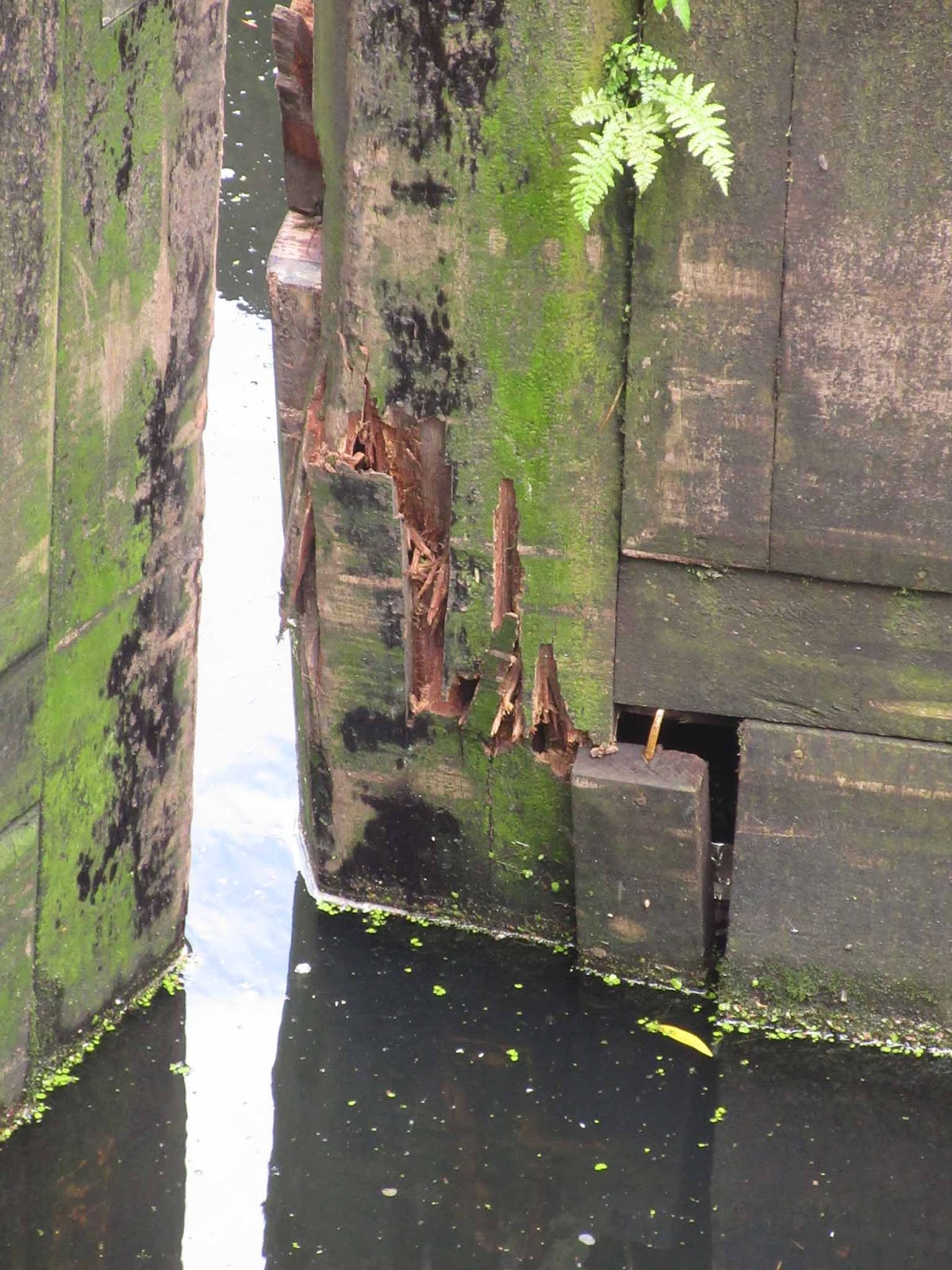
It is a fairly spectacular failure!
We decided that Alan had to go back to the mooring in Northamptonshire by train and bus, retrieve the car that we had left there, come back up to Manchester, then take our valuables off the boat and us to go home for at least a few days. Our plan was to take David home until such time that we could restart the journey so that we would reduce pressure on water, power and toilet. If we had stopped at Littleborough we would have had access to water and toilet, but where we were there was no where to fill our water tank, or empty our toilet cassettes.


Gates are not meant to rest one on the other!
We drove home, taking any valuables off the boat, and all the washing (so that we didn't have to use the limited water supply on the boat). While there we went up to the moorings to see Sickle, which had been painted while we were away. Then after a couple of days Alan and I went back up to Flamingo at Chadderton. 

With a car we could drive to the nearest Elsan emptying point - some eight miles away across Manchester, and involving a 4 lane motorway. We also filled some large water containers that we had fished out of Sickle's hold so that we could eke out the water for longer. We stayed clean by going to the local sports centre for a swim and a shower. I at least got to go running up and down the towpath carrying on with working through the NHS couch to 5K programme.


By the 25th a coffer dam was in place to allow the lock to be pumped out.
We were on the edge of the town, with fields by the boat, but with a large housing estate starting very near to the boats. It wasn't an unpleasant place to be, but there was quite a lot of foot and bike traffic past the boats, and we didn't want to be too obviously abandoned by the canal. Lynnette was on Saltaire in the evenings, when other demands on her time allowed, and we tried to cover times when she wasn't available to be on the boat. 

This looked like overkill by CRT, as all work was limited to the bottom end.
Local people walking by started to notice that the boats had been there for a couple of weeks, and they started asking questions. There is not much you can say but the truth, so we told people what had happened if they asked. Then the next day we would have people stopping to chat saying 'you are the people that are stuck here, my friend told me all about you'. So much for trying not to be noticed.


Some of the detritus removed from lock bottom 
- up to 30 bikes for a start!
This went on for four weeks. We drove up and down the motorway, trying to be at home for Morris events that we said that we would be attending (including 4 events in 3 days). I found the driving particularly exhausting.

However, we were determined to take our newly painted Sickle to Braunston historic boat show - as it may be one of the few historic boat rallies we can get to this year. We had a fantastic weekend, in excellent weather, and saw many of our friends.


However no effort was made to remove trolleys below the lock, I think.
Finally, CRT had got the lock gate rebuilt, and a new quoinstone into the lock. They opened the lock on Thursday 4th July - a day earlier than originally scheduled. We couldn't do that date because we had planned for us all to drive back to Chadderton on the Thursday, and Alan to return the car to the mooring on Friday by reversing his journey. Alan had already booked the train tickets for Thursday. Both times, as well as the longish drive, it involved 3 trains, one bus, and a fair amount of waking.

We arrived at Chadderton on Friday 7th June, we left on Saturday 6th July. Four weeks. Added to the time we had to stop at Hebden Bridge this means that on our 'big trip up North' we've spent more than 5 weeks kicking our heels somewhere trying to eke out water and power.

Sunday, 30 June 2019

Braunston Historic Boat event with Sickle.

(Boat Sickle - posted by Alan)
(Retrospective post for Saturday 29th and Sunday 30th June)


We had two excellent days at Braunston with Sickle, and for once rain was the least of our worries.  In fact the major problem we faced was overheating - Saturday was exceptionally hot, and Sickle's back cabin rather stifling overnight.  Fortunately by Sunday although temperatures were still high, things had cooled down a bit.

Cath took Sickle around on the Saturday parade, which, not unusually, proved to be the busier one.  I took the tiller on the Sunday parade.

Too many photos to post in line here, but hopefully this Flickr album gives a fair idea of both parades.

Link to Flickr album


Two Parades
Miles 2.4, Locks: 0
Total Miles 12.9, Total Locks:13

Friday, 28 June 2019

But meanwhile we had another boat.

(Boat Sickle - posted by Alan)
(Retrospective post for Friday 28th June)


First lock - Buckby Bottom.
Flamingo being trapped in by the long term lock failure on the Rochdale canal didn't necessarily mean a stop to all boating activity until the lock was fixed and we could escape. 

We had always planned to take both boats, Flamingo and Sickle, to the Braunston Historic Boats event, but clearly Flamingo had ceased to be a possibility as soon as it became clear how long the Rochdale stoppage would inevitably last.


Moving towards next Buckby lock.
In fact whilst we went away with Flamingo, Sickle had been left with the local boat painter, Colin Dundas, for a complete repaint of its topsides.  We had now owned her for some 8 years, and the paint was already some years old at the time of purchase - it had generally held up well, but was now tired, and in need of a full refresh.  Colin had done an excellent job of meeting our requirements for a revised livery, and the work was complete.  We could take Sickle to Braunston if we were prepared to leave Flamingo unvisited for nearly a week up in Lancashire - we considered carefully and decided it was a slight risk we were prepared to take.


Cath takes over for the Braunston flight.
The principal reason Sickle has seen little use on its own for several years, and generally only travels about with Flamingo, is that since we inherited a second large black dog, back cabin living has ceased to be possible.  Cath, Odin and I could squeeze into a back cabin for night time, but fitting Max in as well is a step too far.  So we had to negotiate with the sons that they would have the dogs for the duration of us travelling to Braunston, attending the show over the weekend, and then travelling back to our home mooring - a bit tricky as David was scheduled to be involved in other things.  However a deal was struck, so we were on.


Working down Braunston
There were several things needing close consideration.  Much necessary stuff had been removed from Sickle prior to it going in the paint dock.  We had to work out what all that was, and ensure we had all key items necessary for 3 or 4 days on board.  Mercifully Colin was true to his word, and very little of the inevitable mess from removing all the paint back to metal had found its way inside the living space - we had very little additional cleaning up to do. We also needed to be aware of the short opening hours at both Buckby and Braunston locks.  Effectively we needed to be installed on the boat the previous night, if we were to get through both trouble free in the same day.  So we actually headed up to the mooring on the thursday afternoon/evening.

First time the name has been on the front in very many years.
It was great to be out with Sickle again - a very useful chance to do some boating whilst Flamingo could go nowhere, and Sickle on the Grand Union is a very different prospect from Flamingo on the Rochdale as well.


Goodness knows how many photos I've take at "Pub" lock over the years!
We think Sickle looks superb, (although given what it cost, I would have been very disappointed if she didn't!).  Flamingo is externally very "tired" and unlikely to get addressed for a year or two yet.  So it is very pleasing to once again be able to present at least one of the boats with its paintwork and sign-writing in very good order. 


Sickle is 6th amongst the 7 tugs stretched across the canal.
We had some tricky choices about exactly what scheme to use, and what directions to give Colin about the finer detail, but we think it has worked out very well indeed. Colin is a superb sign-writer, and amongst other things has entirely hand painted the "British Waterways Transport" logos, as well as painting "Sickle" onto the bows in an area that actual has Sickle's former British Waterways "asset number" crudely added in raised weld.  We didn't want to destroy that bit of Sickle's long history, and Colin having worked over the top of it has produced a result that has far outstripped what we thought might be possible.


High House Wharf to Braunston
Miles 10.5, Locks:13
Total Miles 10.5, Total Locks:13

Friday, 7 June 2019

Rescuing goslings, the notorious Lock 61 again, and some very bad news.

(Boat Flamingo - posted by Cath)

Very late post for Friday 7th June 2019 - please see the explanation at the end.


Leaving Littleborough past other boats held up by Rochdale failure.
Because the weather forecast was for rain later in the day we started fairly early, getting going at just after 8 am. The sky was blue, with a few wispy clouds.

Down through Durn Lock - another one at a time lock - then we met up with Lynnette on Saltaire again, who has a friend, Paul, assisting with working the boat today.


More of the same - Bath & Beatty
There is a longish pound through Rochdale, and then we got Lock 49, which has been subject of a stoppage for nearly two weeks. We got the boats in the lock, and drew the paddles, but almost immediately Saltaire 'hung' (this is the boat catching on something as the water starts to empty out of the lock). Both boats are wider than many modern narrow boats, so this is always a danger, but no problem, it was spotted quickly, we 'dropped' the paddles and filled the lock again from the top. We moved Flamingo as far forward as possible, and Saltaire as far back as possible (without risking it on the cill at the back of the lock), then emptied the lock very slowly, checking all the pinch points all the time. The problem was that some of the coping stones at the top of the lock were slightly overhanging the rest of the lock, once we were past those the lock emptied with no further problems.

Totally grounded in narrows for a swing bridge.
Then on to three 'Blue Pits' locks just south of Rochdale. As we shut the gates for the last one, at about 12:15, we got the first few scattered raindrops. At about this time Lynnette got a phone call to tell us that Lock 66 was broken. That's further than we planned to go today, but if there is a stoppage, then we won't be able to get to Manchester tomorrow. It eventually turned out that due to 'boat impact' the 'mitre-post' on the bottom gates has been damaged, meaning that the gates won't seal. (Note: it later turned out that it had nothing to do with a boat - the lock sprang apart on its own)

the lock in Rochdale that had caused our first week of delay.
By the time we got to the Slattocks flight the heavens had opened. I've rarely seen quite so much rain - I suppose it's needed, but it made everything slippery and dangerous.


Clearing one of many propeller fouls on Saltaire.
Slattocks is supposed to be a corruption of 'South Locks', which makes some sense, but I always think that it should be some mild and affectionate insult - 'Ah, get on with you, you gurt slattock!'


Rescued goslings.
At one lock there were a pair of Canada Geese hissing at me, and waving their wings, but I couldn't see why. They don't usually do this if they haven't got goslings. Then I saw them, three very young goslings in the lock, just by Flamingo's bow. The parents had got out of the lock when the boats went in, but the babies couldn't make it up the couple of inches from the top of the water to the lock-side. I didn't expect to be able to do anything, but I knelt down at the lock-side and scooped the babies out one at a time, while the parents stood back - although I half expected an enraged goose to attack me. The babies seemed quite tired, stumbling as I put them onto the lock-side, but they waddled to their parents. Once they had gathered the babies up again the parents returned to threatening me.

We carried on down the flight, it was wet, cold and miserable for most of the way, although it eased to drizzle later on.


Very worrying "repair" to disused railway bridge at Lock 61!
At lock 61, which was the lock that we stuck very firmly in on the way up, we planned carefully. It was very clear that despite the reports, the lock had not been fixed. The pound below was very empty, so we ran some water down. We put Saltaire on the side of the gate that would open, and Flamingo behind the fixed gate. Then we slathered washing up liquid on the widest parts of the boats. Lynnette nudged the boat up to the point that the boat stuck, then opened the throttle as we tried 'bouncing' the other gate. Slowly, very slowly, Saltaire slid out of the lock. Then we tried with Flamingo. Once again, the boat left the lock slowly, but we were out in a fraction of the time that we took getting unstuck last time.

Two more locks and we were at the moorings. Quarter past four, about 8 hours in all. Tiring, but not a bad day.

Now we have to find out what is happening about Lock 66, and when we will be able to continue our journey again.

Note: This post was written the same day as what it refers to, but has deliberately not been published until 4 weeks later.  We decided that if we were going to have to leave a boat for periods on an unattended tow-path over 200 miles from our home, it was probably best to publicise the fact as little as possible.

Littleborough to Rose of Lancaster, Chadderton
Miles 8.7, Locks: 17
Total Miles 213.0, Total Locks: 242

Thursday, 6 June 2019

A short day to set ourselves up for the longer ones

(Boat Flamingo - posted by Alan)


Our overnight mooring with a view.
Yesterday we had made it across the Rochdale summit, after which all locks into Manchester are downhill.  We had considered trying to progress further down to Littleborough, but when I surveyed the state of the flight of 10 locks in total, I found some very low pounds, (a pound is the length of canal between two locks), and some short ones that were completely empty. 


Looking towards first lock on descent from the short summit.
We didn't have the experience of this canal to know how much water we would need to bring down into these pounds in order to get Flamingo's working boat depth through each of them, but the answer was at least "quite a lot".  Hence we didn't know how long it might take, so we decided to not try - once you start you really need to keep going, and we didn't want to run out of daylight, (or enthusiasm - which was by then a real risk!).


Impressive but derelict building besides Lock 42.
I had cycled down to meet other boaters who had spent more than a week at Littleborough waiting for Lock 49 to be fixed - unsurprisingly most wanted to get away in the morning (i.e. today) if possible, so I had let them know we were likely to stop where they were, and to try for a clean run through on Friday.


Absurdly short balance beam, with no alternate way to open gate.
We didn't need to make a particularly prompt departure from the summit to do such a short trip, so didn't actually start until around 10:00.  This may have been a good move, as there was some evidence that CRT might have partially replenished some of the lowest pounds from the night before.  However water levels were still very down from the outset.


Levels better here.
When water is short, travelling downhill through locks is much to be preferred to going uphill.  This is because you carry at least one lock of water down with you, but also if you do need to run additional water down you are not pinching it from where you need to go next.  In fact by going exceedingly cautiously,and picking a careful path through where we remembered the deepest water was going up, we were very pleased to run no additional water down at all.  The single lock that we emptied into each pound helped, and the two driest pounds were so very small that that one lock full produced enough depth for us to get to the next one - but only providing we went straight down the middle - no hope of getting near the sides, so I had to largely stay on the boat throughout.

Many locks on Northern Waterways sport these added reinforcements.
Towards the bottom of this sharp but steep descent things improved, with longer pounds kicking in. 


One of the few pounds worth winding the speed control up for.
At Littleborough all but four of the dozen or so boats that had been holed up here last night were now gone - hopefully all will now have passed the problematic lock 49 without issue.  We put Cath ashore at the final lock of our descent go go and shop, then David and I took Flamingo to fill with water and empty toilets on the far side of the canal.  While we were there the owner of a boat permanently moored there returned with his two dogs, one of which proceeded to immediately bite my leg!  I was sufficiently stunned by this to not have a right go at the owner as I should doubtless have done.  I am far too British, and am now sporting a sizeable blood blister.  The dog could have done this to anybody - I got the impression it was not unusual.  I was wrong not to make more of an issue out of it, and I'm annoyed now with myself that I didn't.
Final lock on a short day - we still did ten of them though
Cath arrived back along the tow-path just about at the point the water was full, so David and I "punted" the boat back over.  Even in sleepy Littleborough, it transpires, Cath can manage to find a bookshop not only selling books about Wales, but also actually written in Welsh.  The on-board book collection has grown again - no wonder Flamingo is constantly rubbing on the bottom of the canal!

Tomorrow we will again need to work a lot harder.


Summit to Littleborough
Miles 1.4, Locks: 10
Total Miles 204.2, Total Locks: 225

Wednesday, 5 June 2019

A day of dog related shenanigans

(Boat Flamingo - posted by Cath)


First lock of the day has a guillotine gate at the bottom end.
We wanted to get away fairly early, in case we might be able to get somewhere down the other side of the summit - perhaps as far as Littleborough.

My phone alarm went off at 7:00 am, but I was a bit sluggish and found it hard to get moving. We went and thumped on the back hatch to let David know that we wanted to get moving, but we couldn't hear any answer to our shouts. We need David to get up, not just because he is essential on a heavily locked section like the one that we would be tackling today, but also because the boat tiller is kept in the back cabin, and that's also where the controls are - we can't move the boat without standing in David's bedroom.

The Great Wall of Todmorden looks even larger today, somehow.
It was grey, chilly and overcast, but we were spared the pouring rain that we had yesterday afternoon. We got away from the mooring at 8:30, then up through the guillotine lock - which I really don't like. It's probably fine, but it's a different technique to most locks, so that I spend all my time double-checking everything. 


Impressive railway viaduct crosses the locks at Gauxholme
In that first pound Flamingo got stuck for the first time. Approaching a bridge the boat grounded, and was just not moving, there was just too much debris on the bottom of the canal, and the pound was down a little bit. We all tried pushing and pulling, heaving on ropes, while trying to pole off the 'scour' - nothing happened, so I went up to the next lock, which was full, to empty the water into the pound. I didn't have a great deal of hope, but there was a chance that the water rushing down would 'flush' the boat up a little, and we could escape the scour. In fact, it was possible to get Flamingo moving slowly, and we pulled her through the bridge hole while David stood on the boat with the 'boat shaft' trying to keep the boat away from the off-side, which was particularly shallow. In this situation it is actually often counter-productive to use the engine, even gently. Once there is power to the propeller the back of the boat 'digs in' to the water, pulling down onto whatever it is we are trying to float off.


Not the best wet dog and wet jeans photo ever taken, but you get the idea.
Then, in the flight which climbs up out of Todmorden we had just got to the top of a lock, the gate was open, and the boat was in neutral. Flamingo was most of the way towards one side of the lock, ready to go out of one gate (in broad locks narrow boats should only need one gate opened). A young woman walked past with an attractive dog, so Odin went over to say 'hello'. Max was on the non-towpath side of the lock with me, but he saw this attractive dog and decided that he was going to say 'hello' too. This isn't usually a problem, but instead of running over the narrow bridge at the 'foot' of the lock, he decided to cross Flamingo by jumping onto the 'gap' then trying to jump from there to the other side of the lock - a distance of over 7 feet. He could probably have done this if he had got a run-up at it, or if it hadn't been slightly upwards too (the pound above the lock was slightly down, so the deck of Flamingo was lower than the side of the lock).

Lunch break at Walsden
Max doesn't know that he can swim, and the rise from the water to the level of the gap on Flamingo is more than 2 foot. Poor Max was frantically paddling, and trying to get back on the boat. I just couldn't reach, and whilst Alan could, he wasn't easily able to drag him out. In the end David managed to haul him out, while Alan hung onto David's belt to stop him from falling headlong into the canal too.

The higher you go, the better it gets.
Max celebrated being rescued by shaking and soaking us all with canal water, sufficiently badly in Alan's case decided to change his jeans to the pair from yesterday's rainfall that had still not dried out, as they were drier than the ones Max had left him with.

Then onwards, we stopped for an hour at Walsden to cook burgers for lunch - then onwards again.

It really is like no other canal we have ever travelled on.
As we neared the summit a young woman in a pink top ran past me. I walked under the next bridge and saw a large, grey-ish dog running in the other direction and disappearing around a bend. I just assumed that it was with a walker somewhere ahead of me. Then the young woman ran back past me again, ‘I’ve lost my dog,’ she said. ‘If it’s a large grey dog I saw it running that way,’ I answered, and she ran off to look for it.

Getting closer to the summit.
At the next lock I saw a different woman approaching from behind, with the grey dog. However, as I walked towards her the dog ran off again. I threw a lead to David who set off on the folding bike to try to catch the dog. While he was away the second woman explained that she had found the dog on the main road.


Typical bridge across tail of lock on approach to the summit.
David returned with the dog, which we tied securely to a post by the lock, and David set off again towards the summit in search of the young runner. Unfortunately, the dog didn’t have any contact information on its collar.

Alan and I worked through a couple more locks, dealing with problems when Flamingo got stuck in the run-in to the lock, and taking the dog with us each time we moved on to the next lock.

It is very hard to take photos that 
emphasise just how spectacular it is.
David eventually returned, having been some considerable distance down the other side of the summit, and having spoken to quite a few people. He’d been into the pub, and someone had posted a message on a local FB group. The pub had agreed to look after the dog if we didn’t find the owner.


Today's lost dog was attractive, and remarkably calm without its owner.
At just this point the runner came into view – she must have been completely frantic. She was very grateful that we had keep the dog with us, and was horrified that the dog had been found on the main road.

I just wish that she’d put her phone number on the dog’s collar.

It seems a remarkable coincidence that each time when travelling near the Rochdale summit we have spent time reuniting a lost dog with its owner, but that is exactly what we have now done in both directions.


Top lock at the Eastern end of the summit.
Many of the paddles on this section are extremely stiff. By the time we got to the Summit pub I was completely exhausted, although it was only 4:00 pm. We moored and Alan went off to investigate the state of the pounds on the southern side of the summit, several of which are currently empty. He went to as far Littleborough, where he found the other historic boaters who'd been waiting for lock 49 to be repaired (we've heard today that it is now fixed). They were using their time constructively by sprucing up one of the locks in Littleborough.


Todmorden to Rochdale West Summit
Miles 3.9, Locks: 18
Total Miles 202.8, Total Locks: 215